

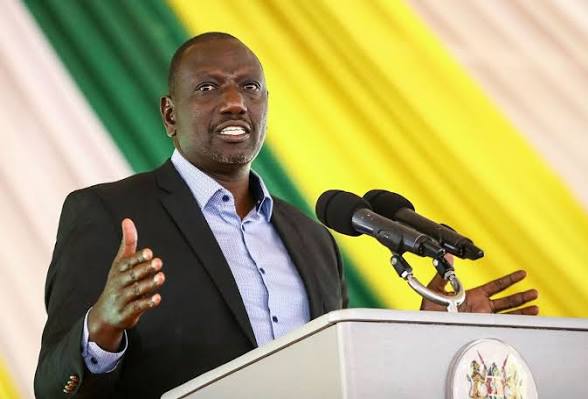
Kenyan President, William Ruto, on Tuesday sought to douse tension following widespread criticism over his earlier comments on Nigerians’ spoken English.
Speaking at the Kenya Mining Investment Conference and Expo 2026, the president told participants that his remarks had been misconstrued and taken out of context.
Ruto made the clarification in the presence of Nigeria’s Minister of Solid Minerals Development, Dele Alake, as he attempted to soften the controversy that had sparked reactions across social media.
“Please convey my regards to President Tinubu, my friend, and to the great people of Nigeria, who are my in-laws,” Ruto said, striking a conciliatory tone.
Addressing the issue directly, he explained that the statement originated from a private conversation with fellow Kenyans, which later became public and, according to him, was misrepresented.
“What I meant was that we Africans speak very good English. In countries like Nigeria, if you do not speak excellent English, you may even require a translator to fully grasp how refined their English is,” he said.
He added jokingly that the backlash had opened room for wider discussions, expressing hope that there would be no “consequences” from his Nigerian “in-laws.”
The Kenyan leader’s daughter, June Ruto, is married to a Nigerian, Alexander Ezenagu, a detail he referenced to underscore his personal ties to Nigeria.
The latest comments marked a shift from his earlier statement in Italy, where he was quoted as saying Nigerians’ English could be difficult to understand, a remark that drew condemnation and accusations of disrespect.
Responding at the event, Alake delivered a measured but pointed reply, reaffirming Nigeria’s stance.
“I bring good tidings from the President and people of Nigeria,” he said. “They have asked me to assure you that Nigerians speak very good English.”
The exchange followed days of online backlash, with Nigerians criticising the initial remarks and questioning their implications for relations between two of Africa’s largest English-speaking nations.
Observers say the development highlights the recurring online rivalry between Nigerians and Kenyans, often seen on platforms like X, where debates frequently mix humour with sharp criticism.
In recent times, such exchanges have extended to issues of governance, economy, entertainment and national identity, sometimes escalating into heated arguments.
Analysts, however, note that the latest engagement between both countries’ officials signals a move to ease tensions and reinforce diplomatic ties.