

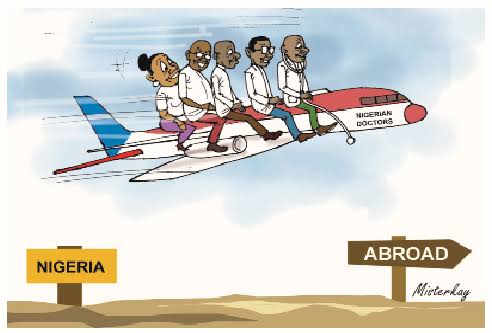
Nigeria’s healthcare system is under increasing pressure as the steady migration of medical professionals abroad continues to weaken the country’s health workforce, the Minister of State for Health and Social Welfare, Iziaq Salako, has said.
Salako raised the concern on Monday while delivering a keynote address at the 2026 United Kingdom Global Health Summit held at the Royal College of Physicians in London.
In a copy of the speech obtained by our correspondent in Abuja, the minister noted that the continued relocation of Nigerian health workers commonly referred to as “japa” has deepened manpower shortages and stretched the nation’s healthcare system.
He disclosed that Nigeria currently has about four doctors for every 10,000 citizens, a figure far below the minimum standard recommended by the World Health Organization, which suggests at least 10 physicians per 10,000 people.
Salako said the shortage of health workers has become a global challenge, noting that Africa accounts for more than a quarter of the world’s disease burden but has less than three per cent of the global health workforce.
According to him, the situation is particularly serious in Nigeria, Africa’s most populous nation, where shortages of doctors, nurses, midwives and other health professionals have reached troubling levels.
The minister said migration has significantly aggravated the shortage of skilled personnel within the country’s healthcare sector.
He cited figures from the United Kingdom showing that about 13,609 Nigerian health workers relocated there between 2021 and 2022, placing Nigeria among the leading sources of foreign-trained medical staff in the UK.
Salako also referenced a 2023 survey conducted by NOI Polls and Nigeria Health Watch which revealed that 57 per cent of Nigerian doctors had already taken concrete steps toward leaving the country to pursue better opportunities abroad.
He explained that the departure of trained doctors represents a substantial loss to the country, noting that government investment in training a single doctor often exceeds $200,000.
According to him, when such professionals migrate, the benefits of that investment are effectively transferred to wealthier countries that employ them.
The minister described the development as an issue of global equity that requires stronger collaboration among nations to address.
Nigeria’s health sector has for years struggled with inadequate funding, poor infrastructure and heavy reliance on out-of-pocket payments by patients seeking medical care.
Despite having a population of more than 220 million people, access to quality healthcare remains limited in many parts of the country, particularly in rural areas.
Experts have repeatedly warned that the continued departure of healthcare workers could further weaken service delivery in public hospitals.
Salako, however, said the Federal Government under the administration of Bola Tinubu had begun implementing reforms aimed at strengthening the health sector through the Nigeria Health Sector Renewal Investment Initiative.
He explained that the initiative is designed to harmonise health policies and financing under a unified framework guided by the principles of “One Plan, One Budget and One Conversation.”
The minister also pointed to wider global factors affecting health systems, including economic instability, climate change and geopolitical tensions.
He cited projections from the International Monetary Fund indicating that global economic growth in 2026 is expected to range between 2.7 and 3.1 per cent, which is lower than pre-pandemic levels.
Such economic conditions, he said, may further limit the capacity of governments worldwide to invest adequately in healthcare.
Salako also highlighted the growing impact of climate change on global health outcomes.
Referring to findings from the Lancet Countdown on Health and Climate Change, he noted that deaths linked to extreme heat have increased by about 23 per cent since 1999.
He added that extreme weather events are also worsening food insecurity in several regions of the world.
In Nigeria, he said environmental issues such as desertification in the northern region, flooding in the southern part of the country and pollution in oil-producing communities are increasingly contributing to disease outbreaks and displacement of populations.
To address the manpower shortage, Salako said the government has expanded training opportunities for healthcare professionals.
According to him, medical school admissions increased by about 160 per cent between 2023 and 2025, while training programmes for nurses, pharmacists and laboratory scientists have also been expanded.
He added that authorities are strengthening the training of community health workers and introducing task-shifting policies to improve healthcare delivery in underserved communities.
Salako also said the government is exploring ways to tap into the expertise of Nigerian healthcare professionals living abroad.
He disclosed that seven Nigerian diaspora medical associations across the United Kingdom, United States, Canada, Germany, Australia and South Africa will carry out a coordinated medical mission in Nigeria between April and July this year.
The programme, he said, will focus on skills transfer, training and strengthening healthcare institutions in the country.
Nigeria is estimated to have more than 150,000 healthcare professionals working abroad, many of whom occupy senior roles in hospitals and research centres around the world.
Salako described these diaspora professionals as a strategic asset capable of helping bridge the country’s healthcare workforce gap.
He called for stronger global collaboration to tackle the health workforce crisis and urged developed nations to adopt ethical recruitment practices.
The minister also advocated the full implementation of the WHO Global Code of Practice on the International Recruitment of Health Personnel, which promotes fairness and transparency in the recruitment of health workers.
He further urged countries to consider bilateral agreements that would allow medical professionals to gain international experience while ensuring that their knowledge and skills benefit their home countries.
“No nation can resolve the global health workforce crisis on its own. Future pandemics or health emergencies will not respect national boundaries.
“Strengthening healthcare systems in developing countries should be seen as a matter of global security rather than charity,” he said.