

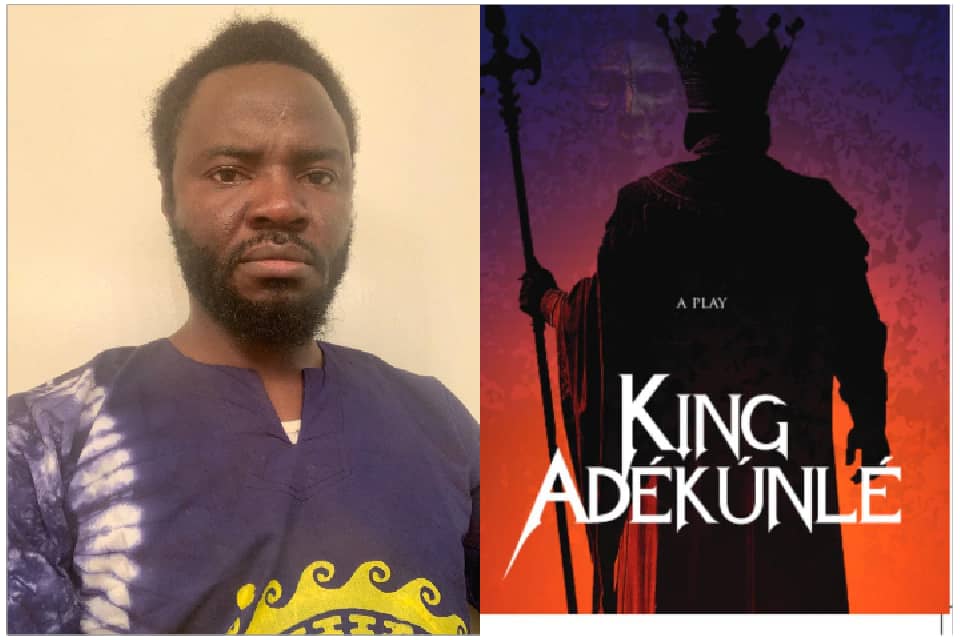
By all accounts, King Adekunle is no ordinary play. First brought to life on stage in June 2012 at The Pit Theatre by the prodigious young lecturer Pelumi Folajimi of Obafemi Awolowo University, the play stunned audiences with its depth, power, and originality. Now, thirteen years after its debut performance, the text of King Adekunle has finally found its way into print, published in 2025 by the Pan-African University Press in Austin, Texas, and Ibadan, Nigeria, a milestone that marks a new chapter in Nigerian dramatic literature.
Inspired by Sophocles’ enduring legacy of Oedipus Rex, Folajimi’s play does not merely echo a Greek tragedy. Rather, it reimagines and reinvents it through the Yoruba worldview’s rich spiritual and philosophical frameworks. Where Sophocles looked to the gods of Olympus, Folajimi turns to Ifa, to the divinities and Babalawo of Yoruba cosmology, and to the rituals that form the sacred architecture of Yoruba life.
At the heart of King Adekunle is the conversation between divinity and humanity, a dialogue made possible through the revered intermediary (Babalawo) who consults Ifa on behalf of the people. In the case of baby Adekunle, the gods speak early: a dark fate awaits him, but rituals, if performed in time, could offer salvation. Yet, the royal household, despite knowing the stakes, fails to act. That fatal inaction becomes the very axis around which the tragic narrative turns.
When we meet King Adekunle again, he is no longer the vulnerable child of prophecy but a grown monarch, beloved and respected. And yet, his fate, long warned, begins to unravel. In the grand tragic tradition, Folajimi shows how fate, once courted and ignored, reclaims its due with devastating effect.
What elevates King Adekunle beyond a mere reworking of Oedipus Rex is Folajimi’s deep commitment to Yoruba cosmology. The play insists that fate is not fixed; it is negotiable, dynamic, and subject to human action. This is a profound shift from the Greek fatalism of Sophocles. In the Yoruba tradition, as depicted by Folajimi, rituals have power, and Ori -one’s personal deity or spiritual intuition can intervene on behalf of the individual, bending the arc of destiny.
The character Fagbemi, a spiritual seer, offers precisely this kind of hope. With prophetic wisdom, he urges the royal household to take corrective actions. But they resist, choosing instead to tread a path of abomination and ignorance, sealing the king’s fate. Adekunle, like Oedipus, eventually comes to realize the truth, but the reckoning arrives too late. His fall is total. His ruin, irrevocable.
Much like Ola Rotimi’s The Gods Are Not to Blame, which similarly adapted Oedipus Rex within a Yoruba context, Folajimi’s King Adekunle is a scholarly and artistic tour de force. But where Rotimi carved a bold path, Folajimi offers a new lens, one that explores how myth, ritual, and human will intersect within Yoruba cosmology.
In its printed form, King Adekunle stands as a monumental contribution to Nigerian theatre, African literature, and comparative mythology. A brilliant fusion of classical structure and indigenous philosophy, the play confirms what many saw back in 2012, that Pelumi Folajimi is not just a playwright, but a visionary dramatist reshaping how we understand fate, power, and redemption.