

By Lanre Olagunju
Over the past three years, a troubling trend has emerged across Africa’s migration routes. Many young job seekers, students, and aspiring migrants are drawn abroad by promises of opportunity, work, study, and a better life. However, they often find that these paths lead them into Russia’s war effort instead. Some end up working in factories that support the frontlines, while others are forced into military service amid the ongoing conflict in Ukraine.
Nigeria, with one of the world’s largest and youngest populations, is at the heart of this issue. The desire to seek a better life abroad, known as the japa mind-set, has shifted from a joke to a serious survival strategy. In the process, many young Nigerians become vulnerable by trusting enticing promises that often lack clarity.
Social media platforms like Facebook, Instagram, and Telegram play a crucial role in spreading these false opportunities, which often appear as sophisticated, polished, and believable ads. As economic pressures push more citizens to go abroad, Nigeria has turned into a prime target for recruiters who exploit ambitions and turn dreams into risks. Investigations have shown that social media is the main driver of a disinformation campaign aimed at young African women. Through appealing digital ads, women from Nigeria and parts of East and Central Africa are promised real jobs, skills training, and a way to get to Europe.
The truth is different; many of them are sent to Russia to work in drone manufacturing in the Alabuga Special Economic Zone. At the centre of this scheme is “Alabuga Start,” a social media brand that disguises military work as empowerment. It features images of diplomas, career advancement, and youthful freedom. Recruitment messages are deliberately vague but targeted, focusing on women aged 18 to 22, a group seen as more easily influenced and controllable. The program mainly targets young women from Africa, but increasingly also includes those from Latin America and Southeast Asia. So far, it has recruited over 1,000 women across Africa for jobs in Alabuga’s weapon factories, some from Nigeria and central and eastern African nations.
The question for the Nigerians in Diaspora Commission (NiDCOM) and the Ministry of Women Affairs is no longer whether exploitation occurred, but whether Nigeria’s gender and diaspora protection frameworks are equipped to confront disinformation that now recruits not with chains, but with clicks. Once abroad, recruits often experience limited communication, coercive work conditions, and environments far from what they were promised.
A continental pattern: Parallels in motion
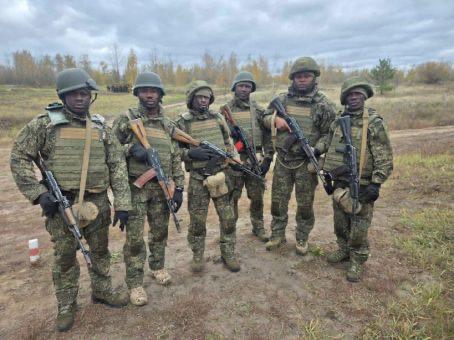
Nigerian mechanic Bankole Manchi, 36, says he left Lagos after accepting what appeared to be a legitimate overseas job promising about N500,000 a month. Instead, after arriving in Moscow via Addis Ababa, he was taken to a military-style camp, where recruits from several countries were told there was “no way out.” Manchi described being forced through weapons training and deployed to the frontline, where he was shot at, poorly fed, and treated, in his words, as a “disposable fighter” in a war he never agreed to join.
Nigeria’s experience is not an outlier but part of a wider pattern unfolding across borders. From Eastern to Southern Africa, the tactics repeat themselves with unsettling precision. Same promises. Same digital couriers. Same quiet disappearances.
In August 2025, South Africa’s government began formal investigations and issued public warnings, advising citizens, especially young women, to avoid unsolicited job offers related to Russia. In Kenya, when it was discovered that many of its citizens had been recruited under false pretences, the authorities intervened. The government shut down unlicensed recruitment networks, bolstered vetting processes, and confirmed that some Kenyans had ended up in military-related jobs in Russia. This change came alongside diplomatic efforts. Musalia Mudavadi, the Prime Cabinet Secretary, noted that these actions followed months of talks with Russia after reports about Kenyans involved in the Russia-Ukraine conflict surfaced. Both governments agreed that those “held without their consent should be released” to the Kenyan Mission in Moscow, “with immediate effect” to allow for safe repatriation. The urgency intensified after a video emerged of a Kenyan captured by Ukrainian forces who said he had been misled into joining the Russian military.
Impacts on Nigerian citizens
For Nigerian nationals caught in these deceptive recruitment schemes, the fallout is real and often long-lasting. Financial loss is often the first hit: many people drain savings or take on debt to pay intermediaries, recruitment agents, and travel facilitators, only to find out the promised jobs were non-existent. Once abroad, their vulnerability grows. Reports from affected Nigerians indicate limited freedom, restricted legal options, and isolation due to language barriers and the confiscation of identification documents. In these situations, their ability to refuse work, seek help, or escape dangerous conditions becomes severely limited.
Muted signals, mounting exposure
Nigeria’s official response to these deceptive overseas recruitment efforts has been cautious and, at times, restrained. Statements from the Ministry of Foreign Affairs have mostly focused on distancing government entities from fraudulent schemes. They warn citizens that legitimate recruitment is “conducted by the Federal Civil Service Commission (FCSC)” and “does not request or accept payments for job applications”. “Members of the public are strongly advised to remain cautious and not to fall victim to such fraudulent schemes” – a statement from the Ministry of Foreign Affairs says. However, a clear national strategy to tackle recruitment linked to foreign conflicts remains absent. Without strong enforcement, continuous public awareness, and effective coordination between agencies, Nigerians are left vulnerable, navigating a digital job market where deception often outpaces regulation.
What policy must deliver
Addressing this threat requires more than warnings; it needs a solid framework. The Nigerians in Diaspora Commission, led by Abike Dabiri-Erewa, must shift from engagement to prevention. This includes establishing pre-departure verification systems for job offers abroad and maintaining a registry of approved international recruiters. The government must also tackle the digital landscape directly by partnering with social media platforms to disrupt fraudulent recruitment networks while launching multilingual public awareness campaigns that reach young Nigerians before recruiters do. More importantly, Nigeria needs a standing multi-agency task force that includes NiDCOM, Foreign Affairs, Labour, Immigration, Ministry of Youth Development, and Ministry of Women Affairs. This group should investigate recruiters, take legal action against offenders, and provide support to victims.
Diplomacy, dignity, and the cost of delay
On a global scale, Nigeria’s challenge reflects a broader failure to protect vulnerable populations from exploitative migration paths. But the stakes are high. With one of Africa’s largest Diasporas, Nigeria cannot afford to be reactive. Establishing formal labour protection agreements, emergency consular protocols, and quick-response systems for distressed citizens must become diplomatic priorities. This is ultimately a question of state responsibility: whether Nigeria will treat citizen protection abroad as episodic crisis management or as a core function of modern statecraft in a time where migration, misinformation and geopolitics are increasingly interconnected?
•Olagunju is a Nigerian disinformation researcher.
Source: The Nation