
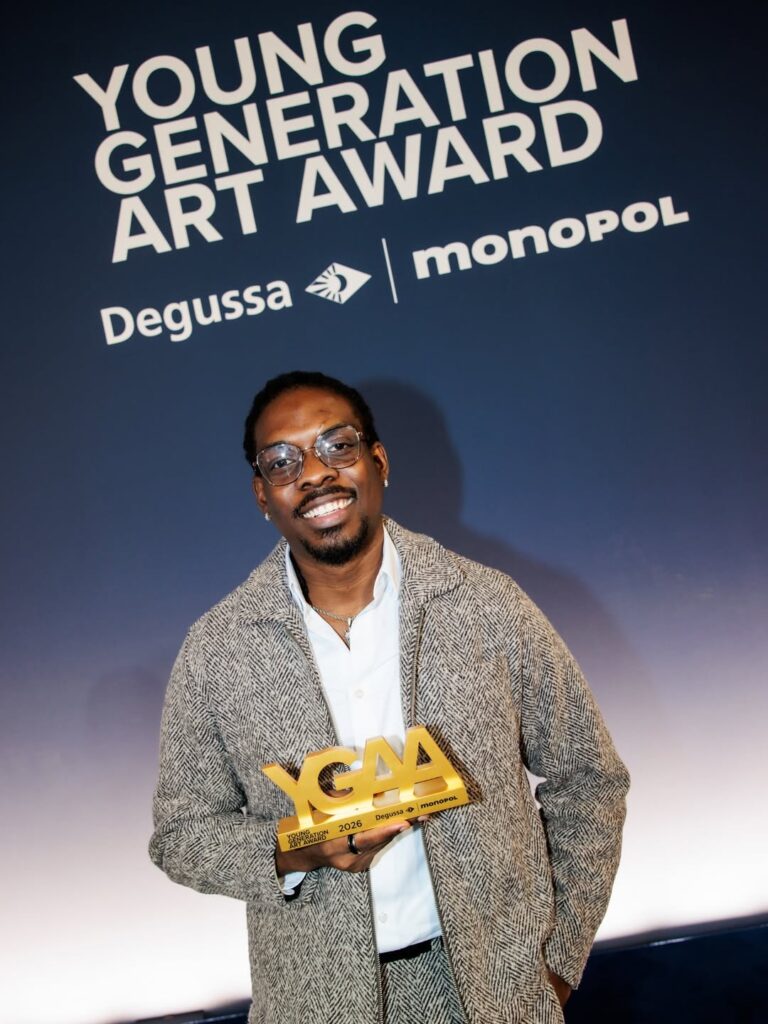
Nigerian-born, London-based artist Ken Nwadiogbu has added a landmark honour to a career already marked by remarkable trajectory, clinching the 2026 Young Generation Art Award at a ceremony held on February 19 at the Hotel de Rome in Berlin taking home €10,000 in prize money, a solo exhibition at Frieze London 2026, and a one-year travelling show across multiple international venues.
Nwadiogbu was selected from a shortlist of five finalists drawn from a pool of nearly 400 applicants, with the award presented to him by Christian Rauch, Chief Executive Officer of Degussa, the German precious metals company that created the prize in partnership with the art publication Monopol magazine. The award was established with the express purpose of supporting emerging artists at the earliest stages of their professional careers.
Few would have predicted the arc of Nwadiogbu’s career from its starting point. A graduate of the University of Lagos who once entertained ambitions of studying civil engineering, he taught himself to draw before eventually formalising his training at the Royal College of Art in London an institution that counts some of Britain’s most celebrated creative figures among its alumni.
Out of that unconventional foundation, he developed what he terms “Contemporealism,” a visual language that occupies the intersection between hyperrealism and contemporary social commentary. His most recognised works vivid, large-scale yellow portraits honouring members of the Black community have earned him wall space at some of the art world’s most prestigious addresses, including the Royal Academy of Arts, Somerset House, Hauser & Wirth, and the Saatchi Gallery.
The Berlin award marks perhaps the most high-profile institutional recognition of Nwadiogbu’s work to date, and arrives at a moment of growing global appetite for African and African-diaspora voices in contemporary art. The accompanying solo show at Frieze London one of the world’s foremost art fairs will place his work before an audience of collectors, curators, and critics whose attention can materially shape an artist’s international standing for years to come.
For Nigeria, the recognition offers yet another reminder of the creative talent the country continues to produce and export and of the platforms that talent finds when it encounters the right combination of opportunity, institutional support, and sheer persistence.