

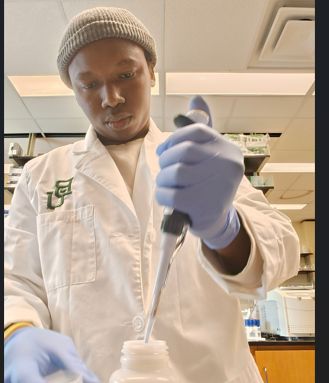
A Nigerian scientist and Ph.D. candidate at Baylor University, Sunday Olaniyan, is making strides in the field of environmental health by investigating how cellular systems can be harnessed to combat pollution.
Olaniyan’s cutting-edge research combines molecular biology, environmental health, and public health to create bio-based solutions that could revolutionise how pollution is tackled globally.
Olaniyan’s academic background is rooted in virology and epidemiology, where he was part of disease surveillance efforts that used xeno-monitoring to detect pathogens in vectors such as mosquitoes and blackflies.
“This work was essential for public health surveillance in detecting early signs of pathogen distribution, especially for diseases like malaria and other neglected tropical diseases,” Olaniyan said.
“Working closely with vulnerable communities exposed me to the harsh realities of environmental pollutants. This drives me to investigate how toxins like cadmium affect cellular and public health.
“NMD functions as a quality control system in cells, and what we are discovering is its vital role in detoxifying heavy metals like cadmium.
Prior to his studies in the U.S., Olaniyan was an Assistant Lecturer at Osun State University, where he taught and mentored biology students. His research excellence has been widely recognised through several prestigious awards. These include the Charlie Guantt Award for Outstanding Achievement from the American Society for Microbiology in 2024 and a Doctoral Research Scholarship from Baylor University in 2022.
In 2025, Baylor further honoured him with a Travel and Presentation Award, enabling him to showcase his work at various scientific conferences.
“Being entrusted to evaluate top-tier academic submissions has been an honour and a testament to my dedication to scientific rigour.
“Through Clean Earth Nexus, we are engaging students and professionals in practical solutions for environmental cleanup, moving beyond theoretical approaches to real-world impact.
“Pollution disproportionately affects vulnerable populations, and scientific solutions must align with environmental justice principles. Bio-based approaches are not just safer but also sustainable and community-driven.
“Pollution is a global health crisis. By understanding how cells naturally defend against toxins, we can develop innovative interventions that protect human health and restore our ecosystems,” he concluded.