

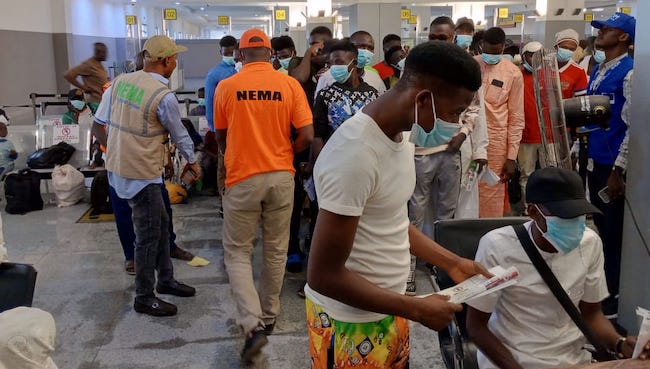
The revelation that over 7,000 Nigerians are currently stranded in Libya has again drawn attention to the worsening socio-economic realities pushing citizens out of the country.
Chairman of the Nigerians in Diaspora Commission, Abike Dabiri-Erewa, disclosed the figure in Abuja during the launch of the International Organisation for Migration (IOM) Strategic Plan for Nigeria covering 2025 to 2027.
Decrying the growing trend, she lamented: “As we speak, 7,000 Nigerians are stranded in Libya. In 2025, people will still travel through the desert to die.”
At the same event, IOM Chief of Mission in Nigeria, Sharon Dimanche, stressed that the plan was a nationally driven initiative.
“This is not just an IOM strategy for Nigeria, it is Nigeria’s strategy supported by IOM, developed through inclusive consultations and shaped by national priorities,” she explained, while urging stakeholders to take ownership of the implementation.
Barely 48 hours after the disclosure, 78 Nigerian victims of human trafficking were flown back from Côte d’Ivoire to Lagos following a rescue mission coordinated by the Federal Government in collaboration with the Nigerian Embassy in Abidjan, NAPTIP, IOM and Air Peace Airlines.
The recurring cases have sparked fresh debate on why many Nigerians risk perilous desert and sea journeys despite the dangers.
Analysts pointed to grinding poverty, soaring food prices, unemployment, and worsening insecurity as the triggers forcing thousands to seek escape routes abroad.
From the North to the South, citizens lamented that they could no longer cope with the cost of living.
Staple foods are increasingly beyond the reach of many households, while hunger and depression are pushing some into desperate choices.
At the same time, violent attacks by terrorists, bandits, kidnappers and other armed groups have left many with no sense of safety at home.
Kidnap-for-ransom has become a lucrative industry, and victims unable to pay often face death or the risk of their remains being sold for rituals.
Interviews with returnees from Libya revealed that many had hoped to reach Europe through the Mediterranean but got trapped. Some believe Libya still offers better economic stability than Nigeria.
A former Katsina lawmaker, Yusuf Shehu, argued that insecurity is as much a driver as economic hardship.
“It may not necessarily be due to hunger and starvation. Many people are migrating due to insecurity because if you look at states like Katsina, Zamfara, Plateau and Benue, there is no reason people in those states would not migrate to any place where they could find peace and security in their lives.
“Those Nigerians who knew that there was a crisis in Libya and still decided to go there believe that even with the situation in Libya, it is still safer than Nigeria and its economy is still more stable than Nigeria’s economy.
“Libya’s currency is much stronger than Nigeria’s Naira in terms of value, so Nigerians would naturally navigate towards such an environment,” he said.
For Mallam Ibrahim Sabiu, the migration was borne out of sheer survival instinct.
According to him, “They couldn’t just fold their hands and watch hunger and starvation ravage them. They needed a place to run to for survival and they felt Libya could be better. Unfortunately, they got stranded as they discovered that things were not as they seemed.
“Also, a good number of them are those who got stuck in Libya from where they planned to enter Europe through the Mediterranean Sea. So, it is not as if all of them planned to migrate to Libya. Libya happens to be one of the trafficking routes to Europe.”
The President of the Middle Belt Forum, Dr Pogu Bitrus, described the situation as a mirror of Nigeria’s economic decline.
“Many of them have been there since the economy took a dangerous dive, with insecurity at an all-time high. So, what you see is a true reflection of our current reality.
“There are a lot of Nigerians in other African countries, who were chased out of Nigeria, because of insurgency and economic situation. So, that is just the reality, but as long as there is insecurity, people will migrate and move out of this country,”he said.
Others like Lagos businessman, Samson Odega, called it a national embarrassment, warning that failure to act swiftly could worsen the crisis.
“A stitch in time saves nine. The government should do everything possible to avoid the looming danger. They should not allow the situation to degenerate beyond what is currently on ground, otherwise, what would follow is what nobody can imagine accurately,” he cautioned.
Migration expert and founder of Patriotic Citizens Initiative, Osita Osemene, believes the only real solution lies in rebuilding the economy and restoring security.
“This number is just a tip of the iceberg. There are more Nigerians who are in terrible situations in so many other African countries.
“I think our leaders should just help us. They should try to fix this country. Nigeria is blessed with abundant human and mineral resources and they should not be found in these kinds of situations.
“The only way to stop people from migrating in such a large number is to fix the country. If the Nigerian economy starts booming, with security of lives and property assured, some of these unnecessary migrations will stop.
“Mind you, many of those people were probably on their way to Europe. They planned to escape to Europe through the Mediterranean Sea from Libya. But, somehow, things did work out well for them and they got stranded.
“So, it is not as if they left Nigeria for Libya; it was supposed to be a transit point before their final destination, which is Europe.
“As for those that were repatriated from Cote D’ivoire, you could say they might have been deceived to believe that things are greener over there. But, when they got there, it was a different situation entirely.
“The truth is that many of them were deceived. Yes, it was easy to deceive them because things are not good in the country but let us bear in mind that they were not given the true picture of the situation over there and that is always the situation.
“They won’t tell you the truth because if they do, you may not want to go and these are traffickers who live off these migrants. So, I think our leaders just need to fix this country and all this nonsense will stop naturally,” he said.