

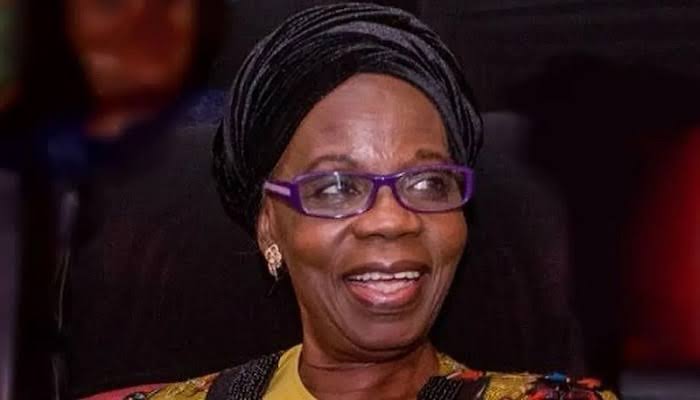
By Joke Kujenya
I was much younger then. But I could recall that her office door was always open as you would see people go in and come out at one time or the other. I watched from afar being a quiet and easygoing young journalist.
On the second floor of the Concord Newspapers headquarters was her office in Ikeja, Lagos, as you drive towards the Murtala Mohammed International Airport (MMIA), tucked behind a modest wooden door engraved simply with “Editor-in-Chief.”
Back then, you might catch the scent of coffee and hear the familiar rhythm clack-clack of a typewriter followed by a sharp ding and a swift carriage return being ready for the day’s newspaper production.
And just beyond that, there she was “Aunty D”, as most of her editorial called her, leaning over a reporter’s shoulder, red pen in hand, her voice calm but firm.
“No, you haven’t asked the second question,” she’d say, pointing to a limp lead paragraph. “The story isn’t what was said. The story is why it matters.”
Well, that pictured how the late Mrs Doyinsola Hamdalat Abiola trained her team: not with commands, but with clarity. Not with the threat of demotion, but the quiet expectation of excellence.
What made her remarkable wasn’t just that she became Nigeria’s first female Editor-in-Chief of a national newspaper. It was that she led as if she had nothing to prove so her staff believed they had everything to become.
Born in 1942 into a quiet but ambitious family, Doyin Aboaba then, grew up with books for company and questions on her tongue.
Her late father, a civil servant, taught her that titles mean little without service, she once said at a training for female journalists hosted by this reporter tagged: Journalism And Women Journalists (JaWS) in 2024 under the Media Mentors Journalism Centre (MMJC) and held at the Excellence Hotel, Ogba, Lagos.
She was the guest Speaker and accompanied by the duo of Mrs. Bimbo Oloyede, ace broadcaster and Mr. Femi Adesina, then, editor of The SUN Newspapers Then, not a few of the 60 female participating journalists determined to take their careers beyond the skies.
The event was sponsored by the telecommunications giant, Mobile Telephone Network (MTN), Nigeria.
Her mother, a quiet force in the home, also taught her that womanhood is not a limitation, but a lens through which power could be refracted, she had taught us too.
Her academic and career voyage was sparked by passion and purpose.
In 1969, fresh from the University of Ibadan (UI) with a degree in English and Drama, she stepped into the newsroom of Daily Sketch as a junior reporter.
She narrated how she had no political godfather. No famous byline. Just her notepad, curiosity, and a kind of courage that moved quietly – but never softly. “I just knew I wanted to do the kind of journalism that everyone would notice.”
Her first column, Tiro, began as a commentary on social injustices, and soon grew into a subtle rebellion, “and that, for an unassuming quiet person like me,” she added smiling. And we all joined her smiles.
She wrote about broken schools and broken promises. About women locked out of power and boys raised to never cry. In every sentence, she stitched truth to responsibility.
But by the early 1970s, while her peers fought for column inches, the late Doyin packed her bags and left for the United States (US), not out of dissatisfaction, but determination.
She said she wanted to master journalism, not merely practice it. Then, a master’s degree. Then a doctorate. Then a return to Nigeria. And then, the choice to the hard path twice, began.
She recalled that on her return, Daily Times offered her the title of “Women’s Editor.” It sounded flattering. It wasn’t. It was a box – and she knew it.
“I didn’t go to New York to return to soft pages,” she later told a friend, laughing. “I went so I could ask bigger questions.”
She declined the role, instead accepting a more rigorous position as Features Writer.
Then, she rose quickly to Group Features Editor and then to Editorial Board Member while working beside intellectual titans like the late Stanley Macebuh and Dele Giwa.
The two men respected her not because she was a woman, but because she was brilliant.
Then in 1980, a phone call came. Would she lead the newly formed National Concord as Daily Editor? “I didn’t blink,” she had said.
What followed was not just the making of a newspaper, but the forging of a national voice – she was to be dutifully engaged in building a paper and building a people, she disclosed.
“At National Concord, I didn’t just edit stories, I created a culture. Do you know what? I had my fears. So, I introduced mentorship schemes. I implemented byline accountability. I made Sunday editors rewrite Monday leads if they lacked rigour and few others.”
“You didn’t want Aunty D to catch you coasting,” said Bayo Onanuga, one of the then young journalists under her watch. “She could tell when you were faking it. And she’d make you try again, not because she was cruel, but because she believed you could do better.”
And under her stewardship, the paper did things no other newsroom had done.
It was the first to digitise its archive using microfilm. It was also the first to run an entire issue dedicated to women’s political roles. Just as it was the first to have a woman at the helm.
By 1986, she became not just the Editor, but the Managing Director and Editor-in-Chief – a dual role unheard of for women in Nigeria at the time.
That same year, she was selected for the Eisenhower Fellowship. Abroad, they applauded her. At home, she kept working.
Under fire, she exhibited a high sense of integrity.
The 1990s brought Nigeria to its knees. Military decrees flew like bullets. The press faced shutdowns, threats, abductions.
Inside Concord House, the soldiers came too. Cameras confiscated. Journalists detained. Headlines censored.
But Aunty D did not flinch.
She stood between soldiers and her staff. She used her voice in backdoor negotiations. She kept the presses running even when the paper was banned.
When her husband, Chief Moshood Abiola, won the 1993 presidential election and the military annulled it, she suddenly became both editor and activist.
“She protected us,” said Dele Alake, who rose under her leadership and later became Editor himself. “She was our firewall.”
He remembers the night they had to send reporters out without IDs so the military wouldn’t arrest them. “She told us: ‘Don’t be heroes. Be wise. The story must be told but you must survive to tell it.’”
That’s how over her three decades at Concord, Dr. Doyin Abiola did more than run a newsroom. She seeded one. And so, she began opening doors that stayed open for her teeming proteges.
She then hired a few young women who reminded her of herself: bold, unsure, brilliant. And she corrected them firmly but without cruelty just as she also celebrated them without spectacle.
“She saw something in me before I did,” said Funke Egbemode, who went on to become Editor-in-Chief of Sunday Times and Commissioner for Information in Osun State. “She didn’t just want women in newsrooms; she wanted women in charge.”
After retirement, Aunty D didn’t disappear. She chaired panels. Judged awards. Designed university curricula.
She said yes to mentorship requests from students with no famous surnames. She read their clippings, circled verbs, and returned them.
She grew to become not just a woman in media but a woman of media. To call her the “first female Editor-in-Chief” is to state a fact. But to understand what she became is to grasp something deeper.
A Career Woman and Mother
At a time when many women were struggling to blend career with the home, Anty D was a mother who taught her daughter that dinner could wait if the newsroom called.
Widowed as a result of Nigeria’s June 12, 1993, fairest election annulment, she carried the pain in quiet dignity and remained a professional who wore no scandal.
Rather, she was a human who made the newsroom a humane place.
Her legacy is not carved only in awards though she received many. It lives in the bylines of those she mentored.
In the careers of men and women who rose from her tough edits and soft encouragement and in every story told with integrity because she once demanded it.
At the final edit, when news of her passing spread on August 5, 2025, the tributes came like a flood, but this story isn’t about her death. It’s about her life as a truly Noble Woman in the history of journalism in Nigeria.
About how one woman walked into a male-dominated newsroom in 1969, and over 50 years, turned the page for an entire generation.
“Aunty D,” they still call her. Even in silence, her name holds weight.
And somewhere in a newsroom tonight, a young woman sharpens her lead, checks her facts again, and says to herself: Doyin Abiola did this. So, can I.
Voices Echo Her Legacy
As news of Dr. Doyin Abiola’s passing rippled across the country, tributes poured in from Nigeria’s highest offices and most respected media voices, each reflecting the weight of her legacy.
President Bola Tinubu led the nation in mourning, describing Dr. Abiola as “a media icon whose brilliance and tenacity broke through the hardest ceilings in journalism.” In his statement, he lauded her as “a pioneer whose leadership gave generations of Nigerian women the courage to rise, speak, and lead.”
From the statehouses, governors joined in honouring her legacy. Governor Dapo Abiodun of Ogun State, her home state, called her passing “a monumental loss to Nigeria’s intellectual and media community.” He praised her “trailblazing spirit” and remembered her as “a daughter of Ogun who rose to become a giant of national relevance.”
Lagos State Governor Babajide Sanwo-Olu reflected on her influence beyond the newsroom: “Dr. Abiola was a woman of grace and intellect. She redefined journalism in our country and inspired reforms in media leadership that still resonate today.”
Also, from the nation’s editorial circles came words etched with deep respect.
The Nigerian Guild of Editors (NGE) called her “a matriarch of modern Nigerian journalism,” stating that “her stewardship at the helm of National Concord remains a case study in editorial courage and professional excellence.”
Former colleagues and editors spoke of her with reverence. One editor who rose through the ranks under her leadership, Nsikak Essien, said, “Dr. Doyin didn’t just edit newspapers; she edited people – sharpening minds, guiding voices, and daring us all to be better.”
And others recalled not just her brilliance, but her grace.
A former senior reporter at National Concord remembered, “She led with poise. You could feel her presence in the newsroom before you saw her. She had the rare ability to correct without crushing and to lead without shouting.”
Culled: JK News Media